Can AI Help Solve the Healthcare Staffing Shortage?

What to know:
AI can help ease the healthcare workforce gap—if clinicians are trained to use it. According to the Covista Care Capacity Monitor, Covista’s research conducted in partnership with Gallup, 65% of healthcare executives say AI can help address staffing shortages at least somewhat. Investment in AI technology is growing, but workforce readiness hasn't kept up. Closing the gap between how fast AI is being deployed and how well healthcare workers are prepared to use it is a pressing challenge for health system leaders.
AI has potential, but staffing remains a top priority
The Covista Care Capacity Monitor found that 76% of healthcare executives already say AI has a somewhat or very positive impact on care quality. However, clinicians have a different focus; only 34% rank improving technology as a major priority for their organization in the next 12 months, while 74% rank achieving adequate staffing as the priority instead. This distinction highlights an important consideration: AI’s promise for improving care is closely tied to the people responsible for delivering it.
To realize AI’s full potential, healthcare systems must equip the workforce to use and oversee it as a partner rather than a replacement. While the Covista Healthcare Workforce Index found that AI could help close 37% of the 2040 healthcare workforce gap without replacing a single healthcare worker, it can’t build patient trust or execute complex care decisions that are essential to healthcare on its own—that still requires a human connection.
Where is AI already helping in healthcare?
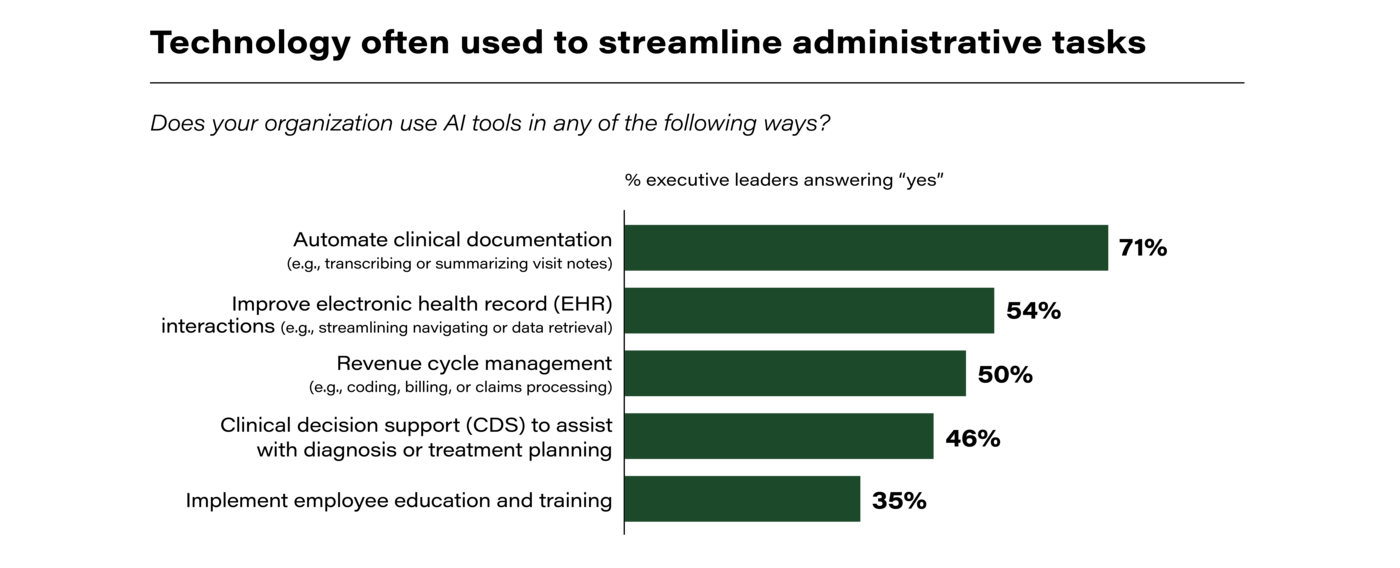
Executives report using AI most to reduce administrative burden: 71% for clinical documentation, 54% for electronic health record interactions and 50% for revenue cycle management. Tools like these streamline the work that can pull clinicians away from patients and potentially free up time for more care. Executives see the effect on care quality too: 20% call AI’s impact very positive and 56% call it somewhat positive.
AI use in healthcare settings is uneven by risk level, and that pattern is instructive for where to invest next. Clinical decision support, the use closest to diagnosis and treatment planning, is deployed less widely than documentation or EHR tools. The closer AI gets to a clinical decision, the more clinicians need training to use it, question it and know when to override it.
What are the barriers to AI adoption in healthcare organizations?
Training gaps, clinician skepticism, limited budgets and trust concerns are key barriers to AI use in healthcare. The technology itself is already being deployed across many administrative workflows but has outpaced the preparation needed to use it well.
Identifying these barriers is the first step toward getting a real return on AI investment:
- Training gaps: 28% of clinicians say they want more training on AI tools or technology, second only to specialty topics in their list of priorities, per the Covista Care Capacity Monitor. However, limited IT bandwidth and fragmented single purpose solutions from multiple vendors make it difficult for organizations to provide the training and support clinicians need.
- Clinician skepticism: Only 45% of clinicians believe AI can address staffing shortages at least somewhat, compared to 65% of executives, and just 6% think it could solve the problem mostly or completely, per the report.
- Budget constraints: Tight budgets limit how much healthcare systems can invest in AI even when teams are ready to bring it into their workflows.
- Trust concerns: Concerns among patients and clinicians about whether to trust AI can limit its impact.
This is as much a change-management problem as a training one. The data suggests clinicians aren't rejecting AI so much as prioritizing more immediate pressures like staffing, stress and pay, which means AI upskilling has to be built into existing workflows rather than added as one more ask on top of an already stretched schedule.
How do health systems close the gap between AI deployment and staff readiness?
Closing the AI readiness gap starts with hiring and training for AI skills by role. Healthcare executives are already thinking this way: 73% say they want physician specialists, nurse practitioners and physician assistants they hire to know how to use AI.
A physician using AI for diagnostic support needs a different level of fluency than an RN using it for documentation or triage support. Treating AI competency as a single hiring checkbox misses where the actual skill gaps sit.
Some health systems are addressing this by building AI fluency into the education pipeline itself, rather than retrofitting it after clinicians are hired. As America’s largest healthcare educator, Covista is integrating AI into the classroom through its recent partnership with Google Cloud, which embeds healthcare-specific AI credentialing directly into the curriculum. There has already been strong adoption across nursing, medicine, social work, counseling, veterinary medicine and other disciplines, and graduates are entering the workforce with a foundational knowledge of the AI tools and concepts being used in modern healthcare environments.
Where this leaves health systems
The next competitive advantage in healthcare AI will come from workforce readiness, not the technology alone. That means AI in healthcare training built into the pipeline, hiring criteria that reflect how each role uses AI and budgets and tracking held to the same rigor as the technology itself.
Explore the full findings across the Covista Care Capacity Monitor and the Covista Healthcare Workforce Index at covista.com/research.